天装战队护星者
新型碳化硅 SiC 晶体管问世,可在 600℃ 高温下工作_我的网站

一 |
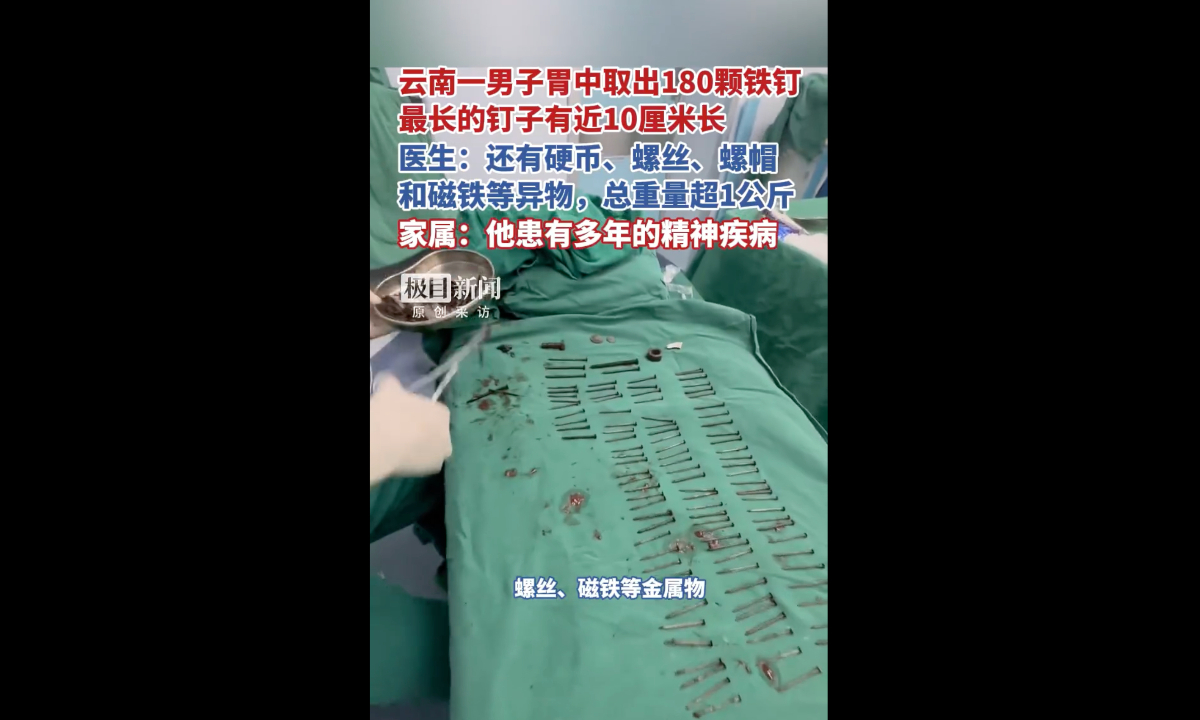
Photo: Screenshot from Sina Weibo
180 iron nails and other foreign objects, including coins, screws, nuts and magnets have recently been removed by doctors at a hospital in Southwest China’s Yunnan Province from a local man’s stomach after he sought treatment for repeated vomiting and abdominal pain, Yunnan Daily reported on Sunday.
The man’s family took him to The Third People’s Hospital of Yunnan Province for examination. Imaging scans revealed a large mass of metal objects in the man’s abdomen, which had clumped together, distended his stomach and caused it to drop downward, according to the report.
The nearly three-hour surgery on Friday removed foreign objects weighing more than 1 kilogram, including a nail nearly 10 centimeters long.
According to Li Wei, chief physician from the hepatobiliary and pancreatic surgery department at the hospital, the patient’s stomach was covered with ulcers and erosions, but fortunately the nails did not perforate the stomach or enter the intestines. The magnets may have caused the nails to clump together, with some nails becoming magnetized. The patient is recovering well and remains in stable condition.
Doctors at the hospital have previously treated patients who swallowed nails, wires and lighters, but this was their first case involving 180 nails.
The man’s family members told Jimu News, a news portal under Hubei Daily, that he had a long history of mental illness and nobody knew why he swallowed so many nails.
Li warns that people should not assume that small swallowed objects will pass on their own, particularly when they are metal or sharp. Such objects can become lodged in narrow sections of the digestive tract and cause injuries or perforation, potentially leading to peritonitis and life-threatening complications.
Global Times
。 8 月 25 日消息,科技媒体 Tom's Hardware 昨日(8 月 24 日)发布博文,报道称京都大学研究团队研发出新型碳化硅(SiC)晶体管,采用标准离子注入工艺制造,可在 600℃(873 K)下工作。援引博文介绍,该晶体管采用商业芯片工厂普遍使用的“离子注入”(ion implantation)工艺打造,相关成果于 8 月 17 日发表在《APL Electronic Devices》。研究团队选择“结型场效应晶体管”(JFET)结构,并将栅极置于沟道下方,形成底栅(bottom-gate)布局。离子注入过程中,部分掺杂原子会沿晶体通道深入目标区域之外,形成“沟道效应”尾部。传统顶栅结构难以补偿这一影响,导致设计阈值电压与实测值相差超过 2 V。底栅结构可捕获偏离预定深度的掺杂原子,让该偏差在 400℃ 下缩小至 0.1 V 以内。该科研团队为了减少高温漏电,团队还加入“双阱”(double-well)隔离结构。该结构通过 pn 结隔离单个器件,避免依赖下方半绝缘碳化硅衬底。参考广告声明:文内含有的对外跳转链接(包括不限于超链接、二维码、口令等形式),用于传递更多信息,节省甄选时间,结果仅供参考,包含外链的文章均包含本声明。
Current article:http://prql.yindabobiehonggaonumiao.bond/o1ykgxc/b4bj.html
Published on:14:02:14





 发表于 11:07:05
 QQ好友和群
 QQ空间
QQ空间 腾讯微博
腾讯微博 腾讯朋友
腾讯朋友 收藏
收藏 支持
支持 反对
反对
 发表于 14:13:54


